


Hello everyone, Eduard here – CEO and Founder of UXtweak.
First of all, on behalf of the entire UXtweak team, thank you for the trust, feedback, and challenges you bring us. None of what we do would be possible without you trusting us with your research.
As we kick off 2026, I took some time to put together a recap of 2025, along with a preview of what we’re planning for 2026 and a few insights I find important and wanted to share with you.
Three pillars we are building the company on
(or how we’re building a research platform differently)

Since founding UXtweak, I have focused on three key pillars that shape the long-term direction of the product and the company.
And I also believe they’re what make us different from other research platforms.
1. End to end UX research platform
Covering the entire UX research cycle – from early concept validation to testing live products.
Not just collecting data on user attitudes and behavior, but analyzing it in depth and creating a central place where researchers can systematically store, share, and reuse insights from UX research.
And where AI assistance will help automate routine tasks, speed up and improve the work of researchers, not replace judgment.
2. Hands on support, that understands UX research
Tools don’t improve research quality on their own, people do. That’s why our customer success team includes actual UX researchers who understand both the platform and the challenges teams face.
This allows us to stand out with personal, professional, and quick support that helps our clients do better and more effective UX research, not just use the platform.
3. Expertise and active contributions to the field
We are actively creating and sharing knowledge with the UX community and contribute to moving the field forward.
We’re doing it through publications in peer-reviewed research on UX methods, educational work, and ongoing community initiatives such as monthly expert sessions, the UX Research Geeks podcast, Women in UX Interviews, community-driven industry reports, and practical articles and videos.
With UXtweak, we are building a service that doesn’t just scratch the surface of UX metrics, but brings a deeper understanding of users and new insights and ways to work with UX research.
I’ve been reflecting on how these principles showed up this year, the wins, the gaps, and what’s next. Over the next few lines, I’ll share:
- A recap of platform updates – what we launched to support our users and what’s coming in 2026
- Research we published and what we learned – our studies focusing on research methodology and the intersection of AI and UX
- Community and partnership highlights – sessions I personally enjoyed the most and notable collaborations
Platform updates – and what’s ahead in 2026
In 2025, our focus was on three things:
👉 helping teams see every detail of what their users are doing
👉 reducing the overhead between data collection and insight
👉 making everyday use smoother through under-the-hood improvements
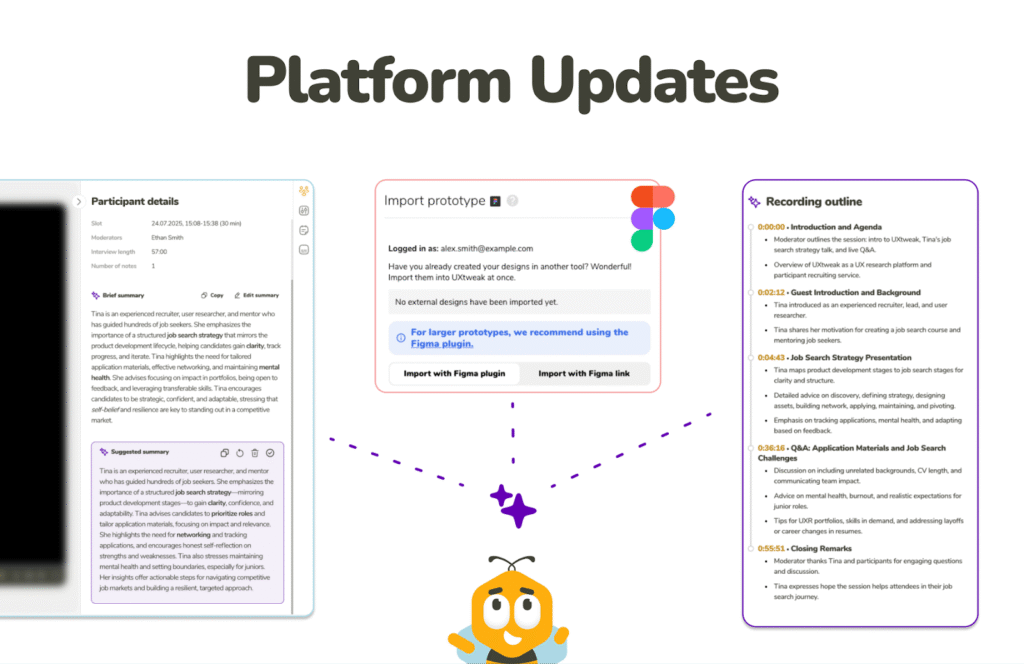
This translated to the following releases:
Screen, voice, and face recordings enhancing analysis across all unmoderated research tools
You can now catch behaviors that would never show up in metrics alone, like confusion in prototype tasks, hesitation during card sorting.
Live Interview transcripts with a full-featured transcript editor
Recordings come with automatically generated transcripts.
Additionally, we’ve included a full-featured transcript editor so you can review and refine the text.
AI-generated summaries and session outlines
Editable summaries and clickable, timestamped outlines help researchers get oriented faster without replacing judgment. No “magic insights,” just time back.
More countries, better filters, and multi-country recruitment
We improved our User Panel with more countries, targeting filters, and multi-country recruitment orders. The process of gathering participants was made even easier and faster.
Faster imports, reliable and secure prototype testing
We launched our Figma Plugin to handle large files, external components, and specific flows with high reliability. It works without logging into Figma through UXtweak, making setup simpler, faster, and more secure.
Visual upgrades, new integrations, and more updates
New integrations (Google Drive, OneDrive, Condens), new question bank for building efficient questionnaires with reusable, customizable questions that can be organized into sections, support for multiple screening questions, redesigned plan management, and laying the groundwork for the redesigned dashboard coming soon in Q1.
These might not seem flashy on their own, but together, they remove plenty of friction from everyday research work.
What we’re working on for 2026
While I can’t share everything yet, here are some of the things we have in the works.
✔️ More capable, context-aware AI features
We completed extensive testing of an upgrade to our AI capabilities that we will be rolling out in early 2026.
The AI will work with a rich, structured study context, including transcripts, all questions and answers, study configuration, moderator and participant metadata, screening criteria, and other study-specific data (such as task flows or interaction events).
✔️ Spreading capabilities from moderated studies across the toolkit
Features currently available in moderated studies, including transcripts, clips, highlight reels, AI overviews, and AI outlines will be gradually rolled out in our unmoderated research tool portfolio.
✔️ Brand new feature: Insights
We’re building a collaborative editor for creating reports and working together as a team. Create, edit and collaborate on creating reports, embed transcripts, clips, highlight reels, and other outputs directly from UXtweak. 🍯
Over time, this will evolve into a full research repository and analysis space. The first version, available for our moderated studies, will be launched in Q1 2026.
Community and partnerships highlights
As mentioned, one of the three pillars we’re building UXtweak on is active contribution to the UX field and the community. That brings me to recap some of the work we did in 2025.
With that in mind, I want to thank all of our partners and collaborators who made last year incredible. Throughout the last year, we have been bringing the community the following initiatives.

Live sessions with UX experts
We continued hosting our monthly live sessions on our channel focused on real-world research challenges. Some of my personal highlights this year were:
- How to Measure UX and Design Impact with Vitaly Friedman
- Driving Business Decisions with UX Research with Nikki Anderson
- The Adaptable Researcher: A Leader’s Guide to Thriving Anywhere with Reggie Murphy
If you have some time, I genuinely recommend watching the recordings; all of our past sessions are available on the UXtweak YouTube channel (make sure to subscribe there to not miss the future ones).
Our next event will be a hands-on session with Debbie Levitt on Using AI in UX Research Analysis, Synthesis, and Reporting, scheduled for January 29.
UX Research Geeks podcast
Our podcast had another strong year.
We covered topics such as why user personas often fail with Jennifer Blatz, why unbiased research is a myth with SL Rao, and how not to waste research with Jake Burghardt.
There are two episodes I found particularly useful and recommend as great intros for newcomers to our podcast:
🎙️ Why Not to Ask Why with Glenn Stevens
🎙️ Turning Research into Impact with Gloria Osardu
Bridging theory and practice
This year, we launched our student program, offering UXtweak licenses free of charge to universities, courses, and educational organizations teaching user research.
I am proud to say we’ve supported hundreds of students and partnered with 50+ organizations, supporting programs and missions of great organizations such as TechFleet, the World Information Architecture Association, and the DIA Design Guild, among many others.
If you’re an educator, you’re invited to get in touch.
Updated AI in UX research report
We published a new AI in UX Research Report, featuring insights from top UX researchers such as Maria Rosala, Kelly Jura, Kevin Liang, Stephanie Walter and others.
We focused on understanding how AI genuinely helps research today, and where human judgment remains non-negotiable.
You can check out the full report AI in UX Research Revisited: What Really Changed Since 2023?, or if you prefer, a webinar AI in UX Research: What Experts Think & Use AI we did on the topic.
Finally, I want to thank everyone who collaborated with us this year – whether as live session guests, podcast contributors, Women in UX interviewees, report collaborators, or thoughtful critics who pushed us to do better.
Looking forward to even more collaboration in 2026!
UXtweak research highlights
We validated validation, explored the potential and risks of AI, delved into established UX practices, and more.
Research is an integral part of UXtweak’s vision, not just the future of our business but the UX field itself. In 2025, UXtweak Research was busy with a range of topics in human–computer interaction.
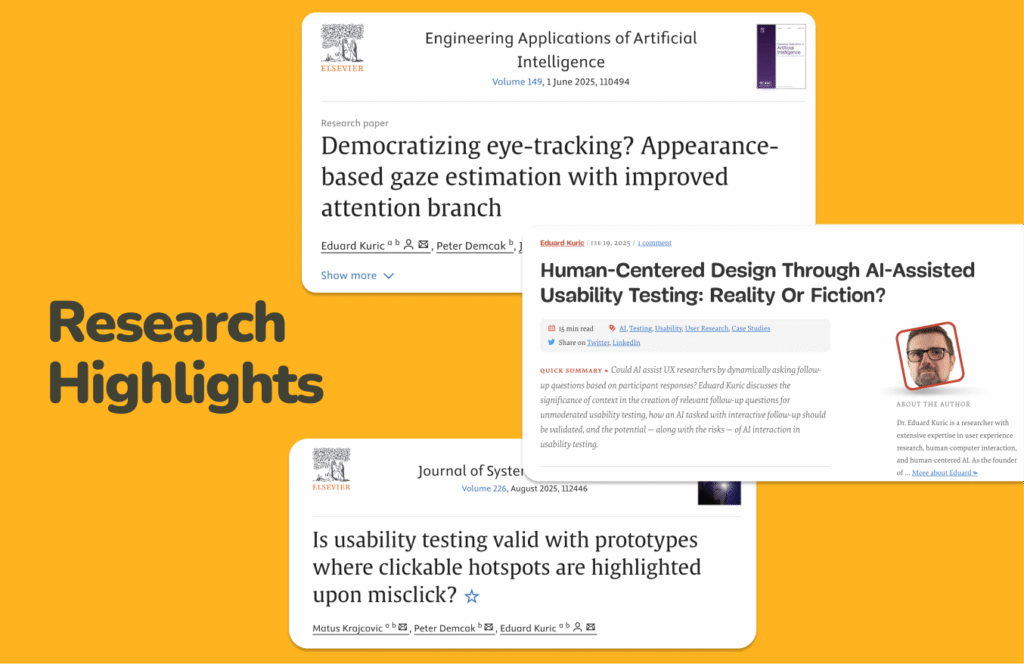
Here’s a summary of articles published in scientific journals:
📚 Card Sorting with Fewer Cards and the Same Mental Models? A Reexamination of an Established Practice
Our team examined the method that allows measuring mental grouping of many items by randomly distributing a smaller subset among individuals. As it turns out, results differ from standard card sorting.
Tree tests are used to test information architecture (IA). However, every tree testing tool differs slightly in the navigation elements it uses, which can affect results. In this study, we validated the validation.
📚 Is usability testing valid with prototypes where clickable hotspots are highlighted upon misclick?
Prototyping tools can highlight clickable elements during testing, raising the concern of leading. We demonstrated that the feature changes participant behavior, discussing the methodological implications.
📚 Democratizing eye-tracking? Appearance-based gaze estimation with improved attention branch
We developed a state-of-the-art neural network model for webcam-driven gaze tracking. We also rigorously examined its limitations, which are shared by similar approaches.
Mouse dynamics are a valuable source of user behavior data, produced constantly on desktop. We used them to predict when the subject is faking in an online personality questionnaire.
Expanding on the article above, we studied the utility of speech patterns (temporal, syntactic and semantic) for enhancing the accuracy of faking prediction.
We have also decided to publish our research as preprints on arXiv. This way, you can sneak a peek at what we have been cooking that is currently undergoing peer review.
These are the topics of our upcoming articles:
- Systematic Literature Review of Automation and Artificial Intelligence in Usability Issue Detection
- Card Sorting Simulator: Augmenting Design of Logical Information Architectures with Large Language Models
- Talking Surveys: How Photorealistic Embodied Conversational Agents Shape Response Quality, Engagement, and Satisfaction
💡 Pro Tip
You can find all of our previous research in the Research by UXtweak section on our website.
I’ve also worked on spreading awareness of our findings through my LinkedIn profile, where I publish weekly.
If you like to stay up to date, I’d love for you to connect with me there (feel free to shoot me a message or a comment there if anything interests you or if you have any questions; I always do my best to respond there).
Additionally, my article, in which I focused on spreading the word about previous research, was published by Smashing Magazine: “Human-Centered Design Through AI-Assisted Usability Testing: Reality Or Fiction?”
Starting 2026, there is even more coming from UXtweak Research, including more studies and a comprehensive literature review of LLM-generated synthetic research data.
We are looking forward to another insightful year.
Thank you for being part of UXtweak (for yet another year)
Thank you for trusting UXtweak as your research partner, for sharing your feedback, insights, and successes with us.
Have a fantastic 2026! 🐝
Eduard Kuric
Founder & CEO, UXtweak