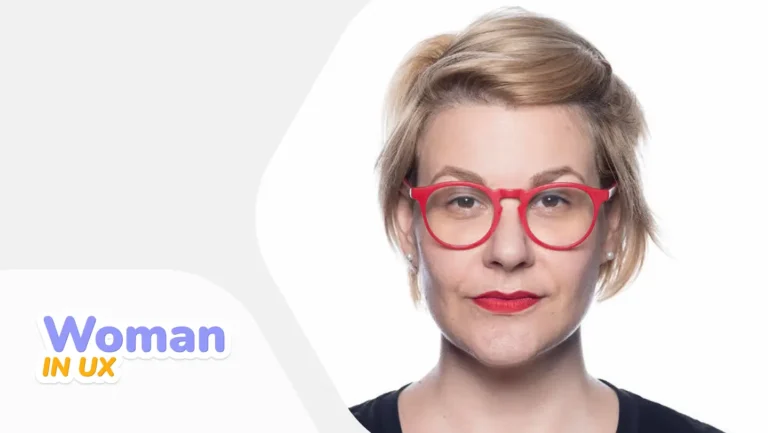

Meet Amanda Gelb – an experienced UX and Product strategist, and the founder of Aha Studio, where she helps startups, new teams, and established organizations transform challenges into clear, strategic steps through deep research and dynamic workshops.
With over 15 years of experience at Google, Lyft, Asana, and HUGE, Amanda specializes in guiding teams to their breakthrough moments.
In this interview with UXtweak, Amanda shares:
🛠️ Practical tips for running effective UX workshops
🔥 The biggest mistake facilitators make in workshops
💬 How to present UX findings without sounding defensive
🎯 Concrete exercises to get stakeholders aligned and unstuck
🧊 Her go-to unconventional ice-breakers
…and so much more! Let’s dive right in!
You’ve worked at some incredible companies (Google, Lyft, Asana) and now run your own consultancy. What prompted you to start Aha Studio, and how has that shift changed your approach to UX?
Honestly? Meeting jail.
I reached a point in my career where I felt completely disconnected from the actual craft of learning, the thing that drew me to research in the first place. I was spending so much time in rooms talking about research rather than doing it.


Starting Aha Studio let me get back to that, but on my own terms. The shift has made me a much more intentional practitioner. When you’re inside a company, there’s always another quarter, another roadmap, another stakeholder to manage.
As a consultant, every engagement has to count, so I’ve gotten sharper about where research actually creates leverage and how to help teams use it.
I’ve also gotten to expand my offerings to training UX and Product Teams around the things that gave me the greatest success in-house as a researcher- stakeholder management: asking better questions and leading group decision making.
UX Workshops
What’s the biggest mistake you see people make when running workshops, and how can they avoid it?
Designing for comfort instead of progress.
Most workshop facilitators, especially new ones, optimize for the room feeling good. They want people to leave saying “that was fun.”
But a workshop that everyone enjoyed and a workshop that actually moved something forward are not the same thing, and confusing them is the most expensive mistake you can make.
The fix is deciding before you walk in the room what “done” looks like. Not what topics you’ll cover. What will be different afterwards.
You say the most effective workshops “usually involve at least a little discomfort.” What does productive discomfort look like in a workshop setting, and how do you create it intentionally?
It looks like a long pause after a hard question.
It looks like someone saying “I’ve never thought about it that way.”
You create it by designing exercises that require people to take a position, role-play an uncomfortable scenario, or say something out loud they’ve only thought privately. The key is that the discomfort has to feel purposeful, participants need to trust that you’re taking them somewhere.
Productive discomfort is when people are working just at the edge of what feels safe so not panicked, but not quite coasting either.
You emphasize “learning by doing” over PowerPoint presentations. Can you walk us through a specific roleplay or mapping exercise you use, and what makes it effective?
One I come back to constantly is what I call a 'best question' round. Before any research readout or stakeholder presentation, I ask everyone in the room to write down the single most important question this work should answer, before they've seen the findings. Then we share them.
It takes four minutes, and it does three things:
- it surfaces misalignment you’d otherwise spend months discovering,
- it gives quieter people a structured way into the conversation,
- and it shifts the room from passive recipients of information to active participants in making sense of it.
The roleplay exercises I use for stakeholder management work similarly.
👉 Participants pair up, one plays a researcher presenting findings, the other plays a skeptical stakeholder. The “stakeholder” gets a card with a specific objection type: “this is too small a sample,” “we already know this,” “what’s the business impact?”
Then we debrief not just what happened, but why certain responses landed and others didn’t.
What makes it effective is that people learn by feeling the friction firsthand. You cannot learn to navigate a difficult conversation by watching someone else do it. You have to feel the moment when you don’t know what to say next.
What’s the difference between a workshop that “feels good in the moment” versus one that “actually changes how people work”? What are your tips for designing workshops for lasting impact?
A workshop that feels good often just validates what people already believe. Everyone leaves energized because they felt heard but nobody was challenged.
👉 A workshop that actually changes things creates some productive friction, surfaces real disagreements, and ends with specific commitments that are hard to walk back from.
The design principle I come back to: did participants produce something together they couldn’t have produced alone? If the answer is yes, you’re on the right track.
Facilitation as a UX Skill
You teach people how to “finally be heard when they present their work.” In your opinion, what are the most common mistakes UX professionals make when presenting to stakeholders?
Leading with the methodology instead of the so-what.
UX people are trained to show their work, which is a research virtue and a communication liability. Stakeholders do not need to understand how you got there in order to trust where you landed. The other big one is presenting findings as if the goal is to be believed rather than to make something happen. Those require completely different structures. One is a defense. The other is an invitation.
Stakeholders do not need to understand how you got there in order to trust where you landed.
For UX professionals who’ve never facilitated before, what’s one small, low-stakes way they can start practicing this skill in their day-to-day work?
Run the first five minutes of your next meeting differently.
Instead of jumping into the agenda, ask one question that requires everyone to contribute something real before the work starts. Not “any questions before we begin” but something that has a specific answer: “What’s the one thing you most need from this meeting today?”
It costs you nothing and it changes the energy of what follows. That’s facilitation. It doesn’t require a whiteboard or a workshop budget.
How has your own facilitation approach evolved over the years? What did you used to do that you don’t do anymore, and why?
I used to over-prepare the content and under-prepare for the human dynamics. I had beautiful decks and no plan for what to do when someone went sideways, when the energy dropped, or when the most important person in the room checked out twenty minutes in.
Now I spend more time thinking about the people than the slides. Who needs to feel heard before they’ll engage? Who will derail if they feel cornered? Where is the real tension in this room and how do I bring it into the light rather than talk around it?
Spend more time thinking about the people than the slides.
Do you have a favorite icebreaker or warm-up that actually works?
I have 2!
- I ask people to share “the last thing that surprised you.” Not a fun fact, not your name and role. Something that actually shifted how you were thinking about something. It’s specific enough to require a real answer and open enough that anyone can find their way in. And it tells you immediately who is paying attention to the world and who is on autopilot, which is useful information for a facilitator.
- Recently, I’ve also been asking people to share “a question you’ve been sitting with lately” at work or in life. It does a few things at once: it gets people out of task mode, it signals that this is a space for curiosity, and it’s genuinely interesting. You learn a lot about someone from the questions they’re carrying. It also pairs well with the kind of work I do, since so much of my practice is about asking better questions.
For warm up activity- I love getting people to move their bodies and try something silly. It signals this is not a business-as-usual meeting and helps break them out of their current thinking.
Do you have a go-to framework to help a team get unstuck on a specific problem?
👉 I call it separating the question from the answer.
Most teams get stuck because they are fighting about solutions when they haven’t actually agreed on the problem. I stop the room and ask everyone to write down in one sentence what we are actually trying to solve.
We read them out loud. Nine times out of ten there are three different problems in the room. Once you see that, the conflict makes sense and you know exactly where to dig in.
Stakeholder relationships
How do you present research findings when you know stakeholders aren’t going to like what they hear?
👉 I ask them what a good outcome looks like for them.
Note this is not a good outcome for the project, or for the team, but them personally. People are skeptical of research when they’ve been burned before or when they feel like it’s being done to them rather than with them. Asking that question early signals that I see them as a partner, not an obstacle. Then I actually do what I said I’d do. Trust is built in the follow-through.
Women in UX
What is your message to other people in the UX/R industry?
Two things:
1. Invest in the relational side of this work as much as the craft side. The best researchers I know aren’t just great at interviews and synthesis, they’re trusted partners who know how to move people.
2. The skills that make you good at your job are the skills that make you good at your life, and most of us have never been told that.
You have spent your career learning how to ask questions that get to the truth, how to listen past the first answer, how to sit with someone’s uncertainty long enough to understand what they actually need. You did that in the name of users and products and research goals. But those same skills work at your dinner table, in your hardest relationships, in the conversations you’ve been putting off for years.
The irony I keep running into is that UX professionals are often the worst at applying their own methodology to themselves. We know how to interview a stranger about their mental model but we struggle to ask our own partners what they actually need.
We know how to create psychological safety in a research session but we freeze when a colleague is shutting down in a meeting. We know that the most important data is often the thing people almost didn’t say, but we let the almost go in our own conversations.
My message is this: you already know how to do this. The curiosity you bring to your users, bring it to the people in your life. The patience you have for a participant who takes a long time to find the words, have that patience in your difficult conversations. The questions you ask to get past the surface answer, ask them of yourself.
What do you think is the best part of being a woman in the UX/tech industry?
The permission to care out loud.
There is something that happens in UX research that I have not found in many other corners of the tech industry: you are rewarded for being interested in people. Not just in systems, not just in outputs, not just in revenue, but in the actual texture of how a human being moves through the world and what they need from it. That felt, when I first found this field, like an enormous exhale.
👉 I think women in this industry, and I am aware this is a generalization worth interrogating, often arrive already fluent in attunement.
In reading the room. In noticing the thing that almost got said. Those are not decorative skills. They are the core of what good research, good facilitation, and good leadership actually require. The best part of being a woman in UX is that the field, more than most, has created space for that fluency to be taken seriously.
What I hope is that we stop calling it intuition, as if it arrived from nowhere, and start calling it methodology. Because that is what it is.
________________________________________________
If you’re interested to read more of inspiring interviews with women from the UX industry, check out our other Women in UX talks!
And dont’ forget to check out UXtweak – an all-in-one UX research platform. From user interviews, to surveys, card sorts and usability tests – we have it all 🐝