

Key Takeaways
📊 Customer analytics software helps businesses collect and analyze user data to improve digital products and understand customer behavior.
🛠️ Different tools offer features such as session recording, heatmaps, and customer segmentation to track interactions and find areas for improvement.
🚀 Top picks for startups include UXtweak, Google Analytics, Mixpanel, and Crazy Egg for their budget-friendly and all-in-one solutions.
🏢 Top picks for enterprise companies include Adobe Analytics, Amplitude, Qualtrics XM, and Medallia for advanced scale and deep data intelligence.
Why is customer analytics important?
Customer analysis helps identify patterns and trends, allowing businesses to improve user experiences, address pain points, and personalize interactions. By acting on these insights, businesses can boost engagement, increase customer satisfaction, and drive revenue growth.
A major e-commerce site increased its annual revenue by $300 million by changing a “Register” button to a “Continue” button during checkout, allowing users to buy without creating an account.
This simple change reduced frustration for both new and repeat customers, leading to a 45% increase in completed purchasesand significantly boosting sales.
Top 10 customer analytics software & tools
We evaluated each customer analytics platforms based on its description, features, pros and cons, user reviews, and pricing.
Tool | G2 Reviews | Starting Price |
4.7/5 | $105/month | |
4.3/5 | Custom pricing | |
4.5/5 | $49/month | |
4.6/5 | Custom pricing | |
4.2/5 | $29/month | |
4.6/5 | $249/month | |
4.9/5 | Custom pricing | |
4.3/5 | $19/month | |
4.5/5 | Free | |
4.1/5 | Custom pricing |
1. Qualtrics XM
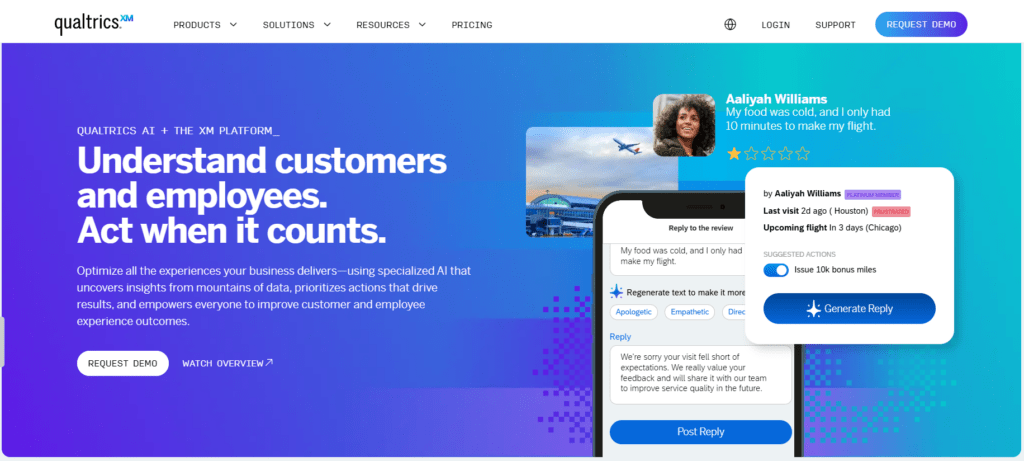
Qualtrics XM is a customer experience management and product analytics platform that enables product teams and businesses to gather, collect, and analyze customer behavior and interaction. Its robust suite of features allows you to get input on each significant customer journey and quickly analyze the engagement that follows. These data turn into insights that help you improve user experience and enhance customer satisfaction.
Key features
- Touchpoint tracker
- Action autopilot
- Detailed analytics
- Predictive analysis
- Social listening
- Survey Questionnaires
- Cohort Analysis
- Performance with integrations
User reviews & ratings
Qualtrics Customer Experience has an overall score of 4.3 out of 5 on G2.
👌 Simple design makes it the thing I like best.
👎 Basic features are not available, such as “if then” for drop down. If you select X, then Y populates. If there is a required field, the red asterisk can not be placed in the proper spot. User hierarchy is not integrated into the platform.
Pros
- Has a great reporting feature that makes it easy to share insights within teams
- Offers flexibility in surveys and questionnaires for customer segments
- Gathers real-time insights from social, email, devices, etc.
- Has a robust real-time analytics feature
Cons
- Has a bit of a learning curve
- The user interface is a bit outdated
- Does not have a free plan
Pricing & plans
Qualtrics XM’s pricing is available on request.
Best for
Enterprise-level organizations looking to run sophisticated, large-scale voice-of-the-customer (VoC) surveys and multi-channel feedback campaigns.

2. Amplitude
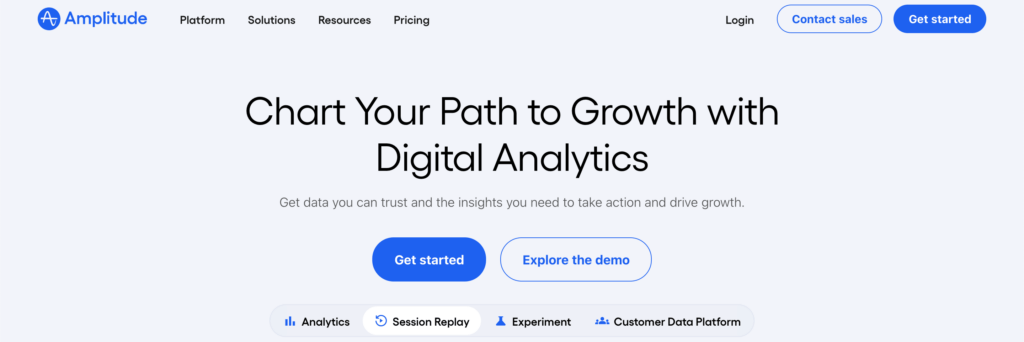
Amplitude is a customer web and mobile analytics solution with cross-platform user journey tracking, user behavior analysis, and segmentation capabilities that enable you to see every path customers take in a single view and zoom in to understand the context and intent behind their actions which helps to improve product experiences.
Key features
- Behavioral cohorts
- Retention analysis
- Pathfinding
- Analytics
- Social Media Channles
- Session Replay
- Custom Integrations
User reviews & ratings
Amplitude has an overall score of 4.5 out of 5 on the G2 review site.
👌 The funnels feature is best. And also I like the user pathfinder feature the most. It helps me understand the actual user journey and other alternatives that users were taking that were not anticipated or intended by us.
👎There was no option to create a custom event on the funnel( or chart section itself). We have to go to govern section everytime to create a custom event. Also, I wish amplitude has provided a bare minimum capabilities to create table like summary.
Pros
- Ability to measure product and marketing metrics
- Has great analytics visualizations that analyze data in many different ways
- Supports configuration and data ingestion to process and segment users
- Has a great customer support team
- Has a flexible business intelligence feature that sets up reports in minutes
Cons
- Doesn’t have an iOS app or any API to access analytics data
- Limitations in dashboards and charts
- There is a bit of a learning curve to go through when setting up events you want to track
Pricing & plans
Amplitude allows you to understand your full customer journey with its free plan. They have a paid plan that starts at $995 per month.
Best for
Deep behavioral cohort analysis and uncovering exact customer conversion paths across both web and mobile product ecosystems.
3. UXtweak
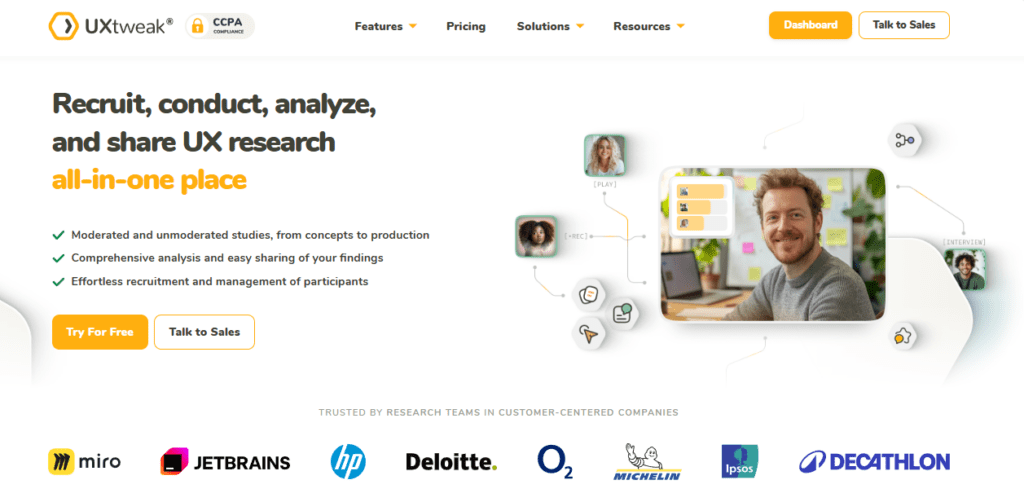
UXtweak is one of the best customer analytics platforms that enables you to gather, analyze, and interpret customer data by leveraging a strong list of features like usability testing, behavioral analytics, and surveys. You can understand how your customers engage with your digital product and draw insights from this data to inform product decisions, enhance customer satisfaction, and optimize user experience
Key features
- Website testing – reveals how users interact with your site, helping you identify pain points, broken flows, or confusing layouts.
- A robust customizable Survey tool – lets you gather targeted, direct feedback from different customer segments, with flexibility to match your brand and goals.
- Session recording – capture real user behavior on your site or app, so you can spot drop-offs, rage clicks, and usability issues in context.
- Prototype testing – allows you to test early versions of a product before launch, helping you validate assumptions and adjust based on real user reactions.
- Mobile testing – ensures your mobile experience works across devices and OS versions, which is key as more traffic shifts to mobile.
- Moderated testing – involves real-time observation and follow-up questions, giving you deeper understanding of customer motivations and thought processes.
User reviews & ratings
UXtweak has an overall score of 4.7 out of 5 on G2, a platform known for collecting independent user reviews.
👌 I love how easy and quick it is to set up the tests. To import the prototype from Figma you just need a link. It imports all your transitions directly from Figma or you can choose to connect the screens manually during setup.
The analytics are great, you can easily filter out specific respondent groups, based on different criteria, and analyze results for each of them. I like that you can get a great amount of qual and quant insights without having to spend hours on the manual analysis.
Pros
- Has easy-to-read analytics that expose user behavior and customer journey analytics
- Has various question types for surveys such as NPS and Likert scale
- Multiple recruiting options: 155M+ User Panel, Onsite Recruiting, from your own database or via URL.
- Supports PDF reports
- Has a free forever plan for small projects
- Has a Multi-operation dashboard with all-in-one functionality
Cons
- Only supports 14 languages
Pricing & plans
UXtweak has designed a variety of pricing plans to suit different user testing requirements:
- Free Plan (€0/month) – Forever free, a great way to experiment with UX research tools at no cost. Includes access to all tools, 15 responses/month, 1 active study, and 14-day access to results.
- Business Plan (€92/month, billed annually) – Ideal for teams that require essential UX research tools and features for their projects. Includes 50 responses/month (upgradable), 1 active study (upgradable), unlimited tasks per study, 12-month data retention, reports and video exports.
- Custom Plan (Pricing upon request) – Tailored for organizations with advanced research needs, providing unlimited active studies, customizable responses, live interviews, access to a global user panel and much more.
For more information on the features of each plan, visit the UXtweak pricing page. 🐝
Best for
Product and research teams wanting an all-in-one platform to seamlessly recruit real users, test designs, and analyze behavior to get both qualitative and quantitative customer insights in one place.
4. Mixpanel
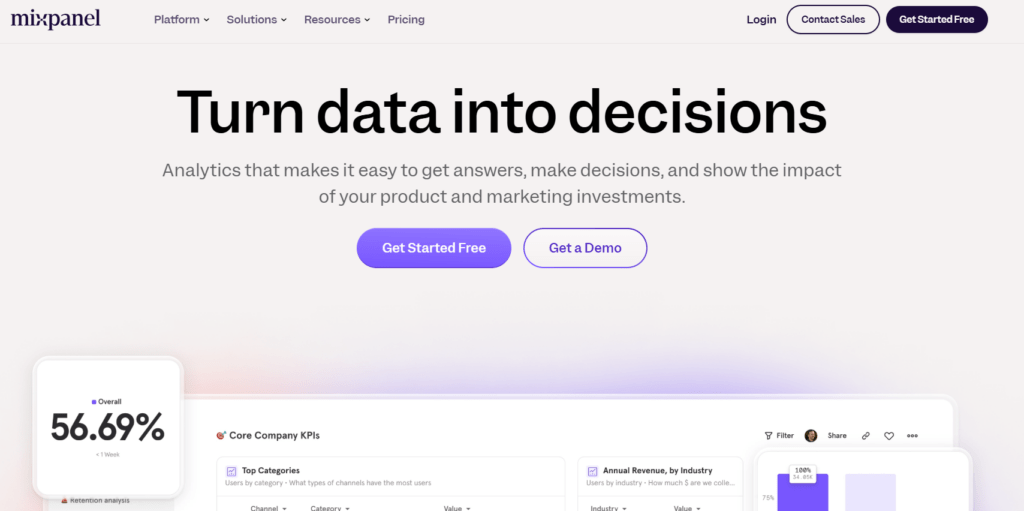
Mixpanel is a customer experience and analytics management software that focuses on product and user analytics, providing detailed insights from customer feedback into each user interaction and customer base with web and mobile applications which helps product teams to understand user behavior and improve product engagement.
Key features
- Engagement
- Standard Event Tracking
- Custom Event Tracking
- Customer Experience Audit
- Retention
- Conversions
- Funnels
- Sentiment Analysis
- A/B Testing
- Critical Insights
User reviews & ratings
Mixpanel has an overall score of 4.6 out of 5 on the G2 review site.
👌 Mixpanel is a really good tool if you want to know user specific interaction or know overall event specific interaction. We are able to use it for AB testing by creating specific reports based on the events, clicks, pages we are testing.
👎 There is not a way to see the most common path users are taking to a specific event. There have been several time where we wanted to know what people were doing before an error occurred and we could not get that information.
Pros
- Ability to track both customer events and profiles
- Ability to collect a wide specter of attributes automatically
- Provides comprehensive documentation to help teams get started with tests and research and receive valuable insights
- Supports mobile, web, and server-side analytic events
- Easy to use and enhance customer engagement tracking and web analytics
Cons
- Reports can have data missing due to errors
- No advanced feature for email tracking
- Duration tracking can report wrong data sometimes on iOS devices
Pricing & plans
Mixpanel’s analytics enable you to convert, engage, and retain more users with its free plan. They have a paid basic plan that starts at $25 per month.
Best for
Fast-moving product teams who want real-time tracking of specific user interaction events, conversion funnels, and A/B test results.
5. Crazy Egg
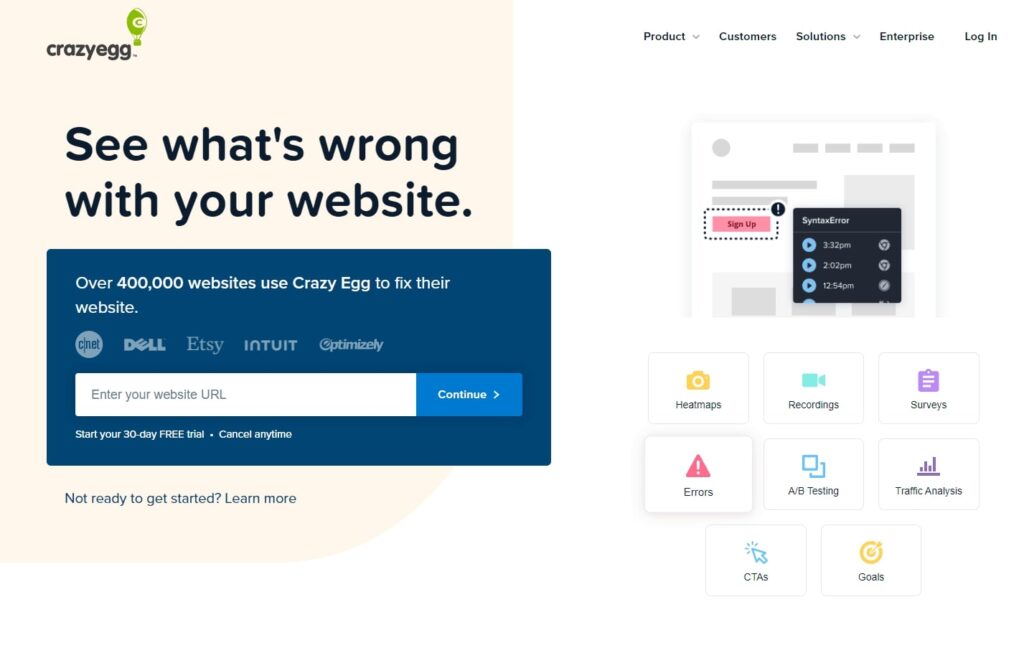
Crazy Egg is a UX research and customer analytics platform that enables product teams to investigate buyers’ journeys, identify various audience segments present across web pages, and recognize issues such as confusing navigation or form glitches to help you observe user interaction and gauge customer engagement.
Key features
- Snapshot reporting
- Heatmaps and scroll maps
- Session recordings
- A/B testing
- Surveys
- Demo dashboard
User reviews & ratings
Crazy Egg has an overall score of 4.2 out of 5 on the G2 review site.
👌 Crazy Egg has the possibility to be such a powerful tool. It’s very easy to add the javascript snippet and to export results. One thing I love is that Crazy Egg allows you to download snapshot results in a convenient zip folder, with different files laid out.
👎The interface is rough. ROUGH. Their menu options are hidden and often times you are left wondering “OK, now what do I do?”
Pros
- Ability to split test pages to see which ones perform better
- Has robust data visualization capabilities
- Easy to use and does not require any learning curve
- Ability to optimize a website and improve conversions
- Has a great A/B testing functionality
Cons
- Limitations in heatmap visualizations
- No possibility of monthly subscription/payments
Did you know?
Some UX professionals on Reddit shared frustrations with tools like Crazyegg, citing issues like performance slowdowns, JS conflicts, and steep pricing.
If you’re seeking a reliable, fairly priced alternative, UXtweak is a standout choice. It offers features like user recordings, heatmaps, and clickmaps without the headaches. Plus, it integrates seamlessly with Figma, Axure, and InVision, which many of our customers love.
Pricing & plans
Crazy Egg has a free 30-day trial on their platform with a paid plan that starts at $49/month to access advanced features.
Best for
Small businesses and marketers seeking an affordable, easy-to-use tool to visualize on-page customer engagement via basic heatmaps.
💡 Pro Tip
Want to know more about Crazy Egg’s price-to-value ratio? Check out our Crazy Egg pricing article!
6. Userpilot
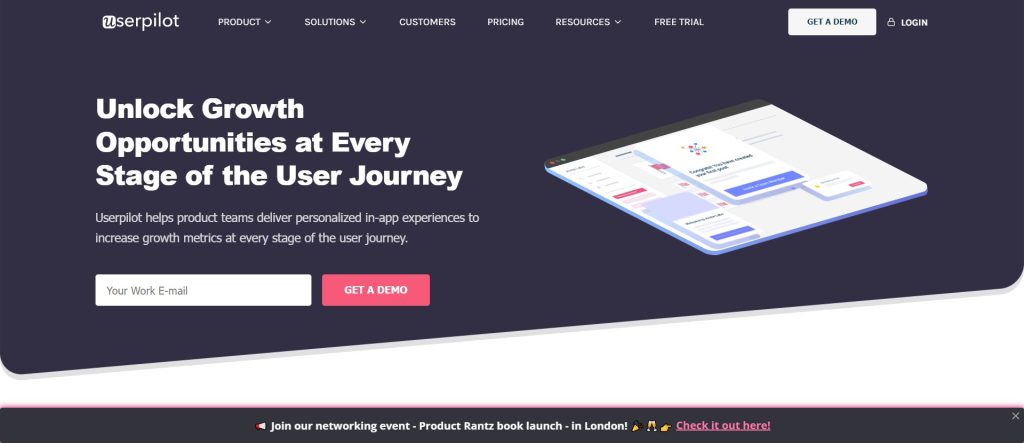
Userpilot is a product experience insights tool that allows product teams and UX researchers to build personalized in-app onboarding, customer interaction, and engagement experiences, view insightful product analytics, and deploy user feedback surveys at every customer journey stage
Key features
- User Segmentation
- User Engagement
- Analytics and Insights
- A/B Testing
- Multi-Language Support
User reviews & ratings
Userpilot has an overall score of 4.6 out of 5 on the G2 review site.
👌Userpilot is simple to set up, use, and does not require any dev – which means instant publishing. This is critical for us as a SaaS company that releases new features frequently; we need the ability to inform our customers of changes quickly, and doing this in our platform through Userpilot allows us to reach the right audience, at the right time, in the right place.
👎Reporting could be better. Some of the analytics in some areas are not as detailed as we would like, such as viewing results per customer segment in NPS reports.
Pros
- Offers essential onboarding template processes tailored to new customers
- Has a great customer support team
- It has a user-friendly interface
- Ability to create custom flows based on segments of users so that different people have different experiences
Cons
- Limitations in analytics features
- Does not offer adequate integration possibilities
Pricing & plans
Userpilot’s paid plan starts at $249 per month.
Best for
Product-led growth teams aiming to track customer feature usage and design personalized in-app onboarding flows to increase adoption.
7. Fullstory
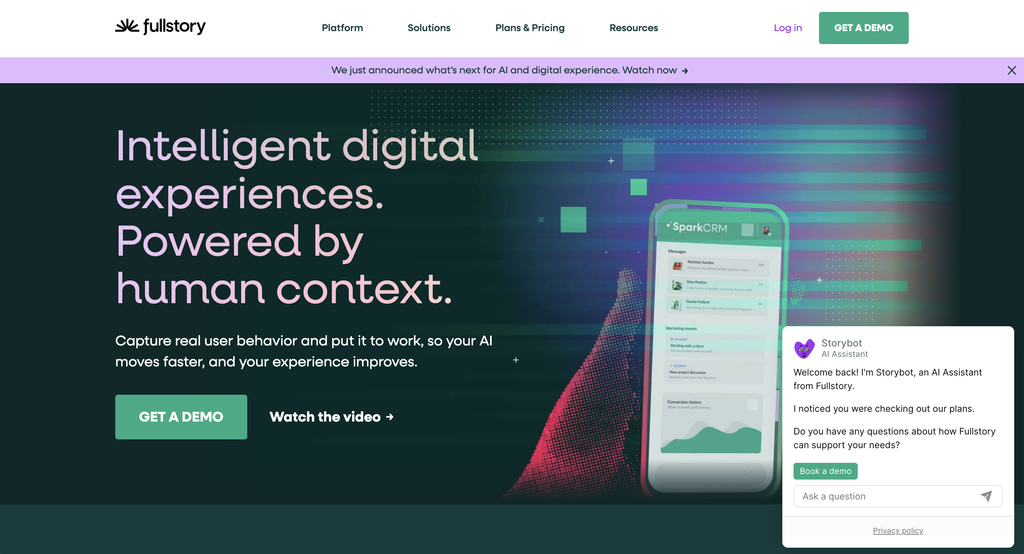
Fullstory is a behavioral data platform and Digital Experience Intelligence (DXI) solution that enables product, development, marketing, and customer support teams to understand exactly how users interact with their digital products. By relying on a patented data engine that automatically captures session data, Fullstory provides a complete picture of the digital experience without the gaps left by manual tagging. It bridges the gap between quantitative analytics and qualitative insights to help teams identify friction, debug errors, track usage, and improve conversion rates.
Key features
- Autocapture (no manual event tagging required)
- High-fidelity Session Replay
- On-the-fly conversion funnels
- Advanced search and filtering capabilities
- Robust debugging and developer tools
- AI-powered features (StoryAI) for predictive analytics
User reviews & ratings
(Note: Sourced from Fullstory’s official customer success stories)
👌 “Workforce gives us empowerment through transparency… Now, I have compelling, objective data to demonstrate the business case behind spend and roadmapping decisions.” — Justin Hauschildt, Director of Enterprise Applications & Delivery Enablement at Slalom.
👌 Flight Centre identified an API-level error that prevented visitors from completing their booking using session replay and Dev Tools in Fullstory, decreasing their booking fail rate by 22%.
Pros
Eliminates the need for manual event tagging by autocapturing every user interaction (clicks, scrolls, hesitations, errors).
Prevents mismatched data by deriving both quantitative analytics and qualitative session replays from the exact same source of truth.
Employs a privacy-first approach that ensures strict data compliance while powering AI integrations.
Breaks down data silos by providing a unified, cross-functional platform for engineering, product, and marketing teams.
Cons
Does not provide transparent public pricing on the website (custom quotes require contacting sales).
Technical constraints on the Developer API, such as a strict 512KB payload size cap and property rate limits.
Dimensionality queries via the API are capped at 50 rows, which makes the platform unsuitable for bulk data exports of large user ID lists.
Pricing & plans
Fullstory’s pricing is custom and available upon request. They offer a free trial for teams wanting to explore the platform’s automated data capture and analytics capabilities before committing.
Best for
Cross-functional teams (product, engineering, and marketing) who want an enterprise-grade, privacy-compliant platform that relies on automated data capture rather than manual tagging to provide deep behavioral insights and fast debugging.
8. Glassbox
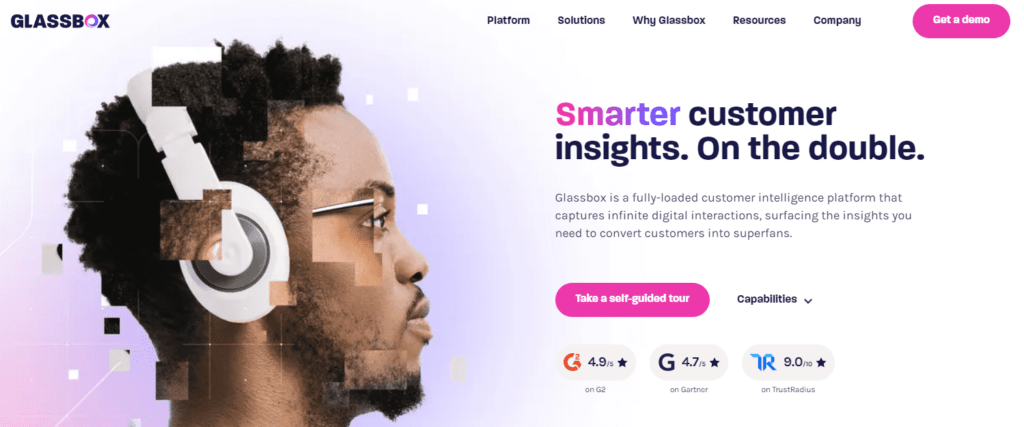
Glassbox is a digital customer experience and analytics platform that helps product teams and businesses record, replay & analyze web & mobile app sessions to understand what customers and users do with your digital products and why.
Key features
- Customer Journey Analytics
- Mobile App Analytics
- Session Replay
- Performance Analytics
- Product Analytics
- Interaction and detailed Heatmaps
- Funnel Analysis
- Struggle and Error Analysis
- Active Users
User reviews & ratings
Glassbox has an overall score of 4.9 out of 5 on the G2 review site.
👌 Click maps are extremely useful, enabled me to remove things from pages that were slowing us down. Funnels an excellent option, can see where we lose people on journeys.
👎 Training helps but it’s not easy, easy to use. I don’t have the time to invest to really get myself up to speed so maybe dont get as much value out of it as I could. Small complaint though as probably just me.
Pros
- Ability to observe and analyze the internal workings of software
- Ability to debug, optimize performance, and understand user interactions
- Supports end-to-end flow in user sessions for analysis and troubleshooting
- Has an intuitive user interface
Cons
- Inability to segment session recordings by IP address
- Issues with re-logging systems
- Session replays are limited to 30 days which can be difficult to access when needed for further research and reference purposes
Pricing & plans
Glassbox’s pricing information is available on request.
Best for
Medium to enterprise digital products requiring high-fidelity website session replays to quickly troubleshoot and debug customer friction points.
9. Google Analytics
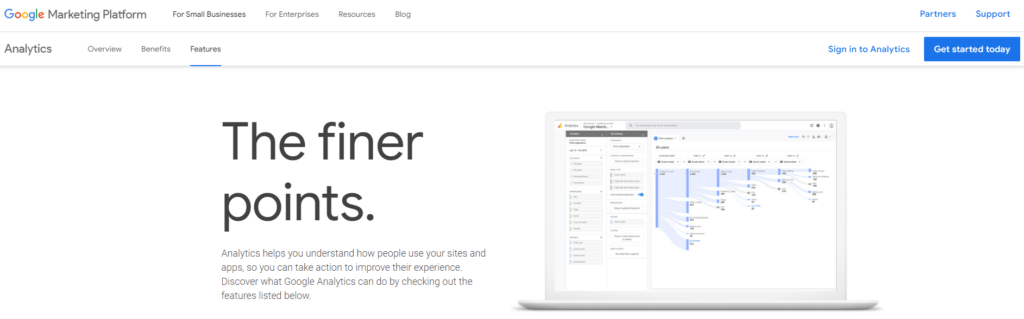
This customer analytics platform provides insights into customer behavior by tracking interactions with websites and apps. It helps identify which content is most effective, enabling businesses to make informed decisions and improve user engagement.
Key features
- Automation and analytics
- Reporting
- Advertising Workspace
- Explorations
- Data Collection and Management
- Advanced-Data Governance
- Heatmaps
- Session recordings
User reviews & ratings
Google Analytics has an overall score of 4.5 out of 5 on the G2 review site.
👌 If you are a small business, this will provide you enough information that you will be able to directionally understand traffic on your site.
👎 For a data and algorithm based company, Google does a terrible, terrible job of estimating reality out of the sampling they do. When we switched to an enterprise web analytics solution that does no sampling, we found that Google Analytics was telling us we had twice as much traffic as we actually do.
Pros
- Has a dynamic heatmap feature
- Color codes data clusters accurately help with data analysis and synthesis
- Ability to log into multiple accounts at once
- It is flexible and adaptable to various industries and business models
- Processes data extremely fast
- Has a great customer service team
Cons
- Difficulty to troubleshoot without contacting support when an error is encountered
Pricing & plans
Google Analytics is a free tool that helps you process customer data quickly.
Best for
Any company needing a completely free, industry-standard starting point to track macro-level website traffic, acquisition channels, and audience demographics.
10. Adobe Analytics
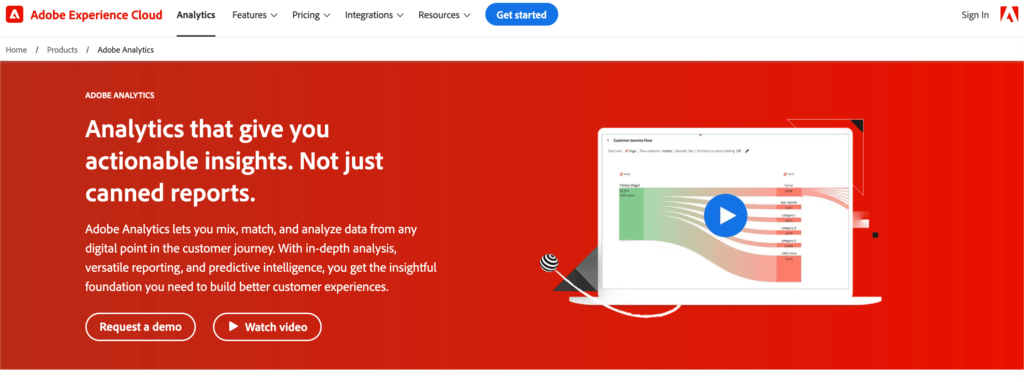
This robust customer analytics solution offers advanced capabilities for product teams and businesses. It provides real-time data, in-depth analysis, versatile reporting, predictive intelligence, and segmentation tools to support data-driven decision-making.
Key features
- Cross-channel Data Integration
- Predictive Analytics
- Customizable Dashboards
- Advanced segmentation
- Real-time Data Visualizations
- Shared audiences
- Web analytics
- Marketing Strategy
- Customer Trends
- Predictive Analytics
- Marketing Campaigns
User reviews & ratings
Adobe Analytics has an overall score of 4.1 out of 5 on the G2 review site.
👌 Adobe Analytics is a great way to standardize measurements over multiple websites.
👎 Editing reporting suites SUCKS. Sorry but the page (I think it’s called Admin Tools) takes and insanely long time to load and in some cases fails to load. This proves difficult for someone trying to iterate quickly or needed to test something.
Pros
- Ability to match and analyze data from any digital point in the customer journey
- It is easy to use once implemented for individual customers
- Ability to create reports and dashboards that are customized to specific digital requirements
- Allows measurement of traffic sources, landing page experience, and customer engagement with site tools
Cons
- Difficult to combine Adobe Analytics with other platforms
- Pricing plans are not tailored to small teams
Pricing & plans
Adobe Analytics’s pricing information is available on request.
Best for
Large enterprise data scientists looking for complex, real-time predictive intelligence to analyze enormous volumes of multi-channel customer data.
Using AI for customer experience analytics
For most product and research teams, the real value of AI lies in eliminating the heavy administrative work that slows down analysis.
Instead of spending hours manually tagging qualitative feedback, cleaning datasets, or sorting through session recordings, you can use targeted AI tools to handle the sorting for you.
We’ve compiled 4 practical tips on how you can leverage specific AI tools to elevate your customer experience analytics and uncover hidden friction points.
1. Scaling depth interviews with autonomous moderators
Instead of using static surveys that only capture surface-level data, you can embed conversational AI interview agents at critical drop-off points using tools like Perspective AI.
The AI acts as a flexible moderator, asking smart follow-up questions based on what the user types rather than relying on rigid, pre-set logic.
Product teams find that this approach bridges the gap between numbers and real insights, replacing low-context metrics like basic NPS with high-fidelity, categorized user reasoning at scale.
2. Standardizing multi-channel qualitative feedback
You can funnel raw customer touchpoints like live support chats, public reviews, and open-ended survey answers into a central workspace using a platform like SentiSum.
The AI instantly analyzes emotional context and tags messages automatically, catching structural issues like product delays or confusing layouts.
According to SentiSum’s customer service analytics framework, this automation removes human bias and gives teams an immediate, clear view of real-time product issues directly from support pipelines.
3. Preserving context across non-linear customer journeys
Consider deploying smart AI agents that connect directly to your backend databases and CRMs using tools like Sierra AI.
Instead of treating every message as an isolated event, the agent uses built-in memory to recall a user’s past tickets, purchase history, and previous web drop-offs.
Industry analysis on modern AI customer experiences shows that these memory-rich systems significantly lower frustration because users do not have to repeat their issues across different channels.
4. Querying relational databases via natural language
To avoid waiting for data teams to write custom SQL queries, you can use generative Business Intelligence interfaces like Tableau Pulse or Microsoft Copilot in Power BI to talk directly to your database.
You can ask simple questions in plain English, like which user group dropped off most during onboarding last week, or what page they visited right before leaving.
Research regarding AI in data analytics shows that conversational BI removes technical barriers, letting product managers and UX designers instantly pull the hard numbers they need to back up design changes.
What is customer analytics software?
Customer analytics platforms track user interactions like clicks, scrolls, and drop-off paths to show how people navigate your digital products.
While standard web tools tell you what is happening, behavioral analytics software helps you understand why it is happening.
A classic example is Jared Spool’s $300 million button case study. An e-commerce retailer was losing millions because their checkout forced users to register.
Behavioral research revealed that first-time buyers resented the forced sign-up, while returning buyers routinely abandoned their carts after forgetting their passwords.
By simply replacing the Register button with a Continue button and enabling guest checkout, the retailer removed this friction. This single change increased completed purchases by 45% and generated an extra $300 million in revenue in the first year.
This is exactly what tools like UXtweak, Mixpanel, and Google Analytics do: they uncover the hidden user blockers that traditional metric tracking completely misses.
Choosing the right tool for your team
Choosing the right customer analytics software is key to improving engagement and growing your digital product.
Instead of forcing you to piece together separate platforms for quantitative metrics and qualitative insights, UXtweak effectively bridges that gap in a single workflow.
As an all-in-one research platform, it enables you to gather and interpret customer data by combining usability testing, session recordings, and surveys.
If you want a comprehensive, practical solution to uncover hidden friction points without managing an overly complex data stack, UXtweak has got you covered.
Try UXtweak for free today and run your first customer test. 🐝